Research
Working papers and publications on development economics, public policy, big data, and machine learning.
Publications
-
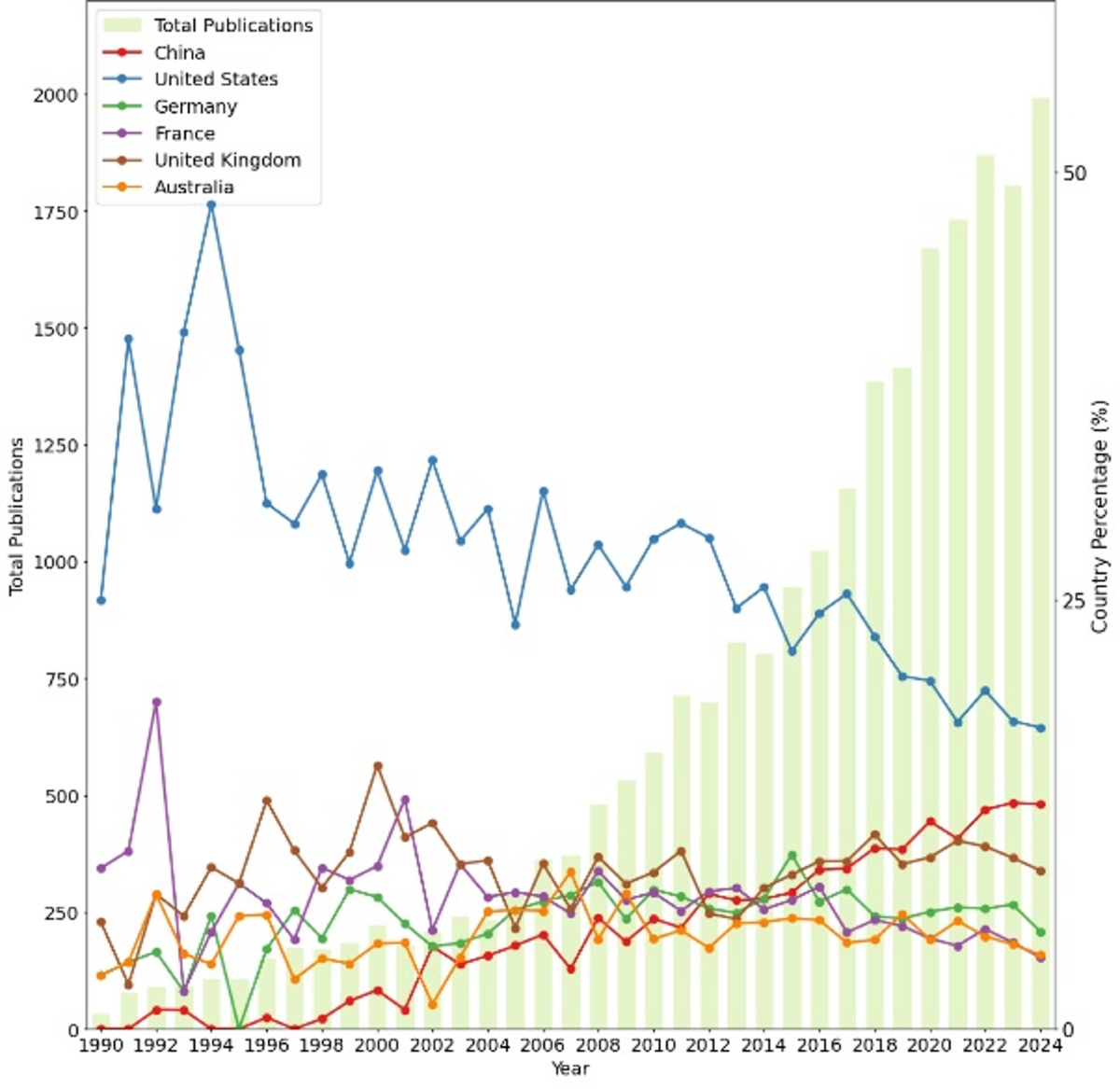 Bibliometric exploration of infrastructure and natural hazards research in low and middle income countries toward sustainable development goalsDiscover Sustainability, Dec 2025A bibliometric map of 23,763 studies (1960–2025) on infrastructure and natural hazards in low- and middle-income countries: LMICs are underrepresented both as study sites and as authors, and telecommunications, coastal protection and green infrastructure are critically overlooked.
Working Papers
-
 When Do Property Rights Reduce Illicit Crops? Market Connectivity as the Binding Constraint2026Working PaperLand titling cuts coca cultivation by 42–64% on impact, but the effect fades within two years — unless titling is paired with tertiary roads to local markets, which sustains a 33–38% reduction.
 -
 Firm Regulatory Compliance and Board Oversight: Does Sending Reports to Colombian Non-Profit Institutions Work?2024Working PaperAn email experiment with 4,600+ Colombian non-profit financial institutions: reports addressed to the board of directors — not only the manager — significantly raise regulatory compliance.
 -
 Restrictions on Urban Mobility and Crime: Evidence from Motorcycle Bans in Colombia2022Working PaperMotorcycle bans adopted to fight crime in Colombian cities show no robust crime reductions — and where effects do appear, crime is displaced to neighboring areas of the same magnitude.


Policy & Technical Reports
-
 Operational Capacity and Prudential Regulation: A Segmentation Study in Credit Unions2024Supersolidaria Technical Document (DTS 002)A k-means segmentation of credit unions by operational capacity, characterized with deposit and credit records of 3.8 million members — evidence for a differentiated prudential regulation.
 -
 School Education for Inclusion and Social Transformation in the Colombian Caribbean2020DTSER-BANREP Working Paper 263A costed big-push for public education in the Colombian Caribbean — preschool, full-day schooling, teacher training, and institutional capacity — to close the gap by 2030 (US$6.3 billion over 12 years).